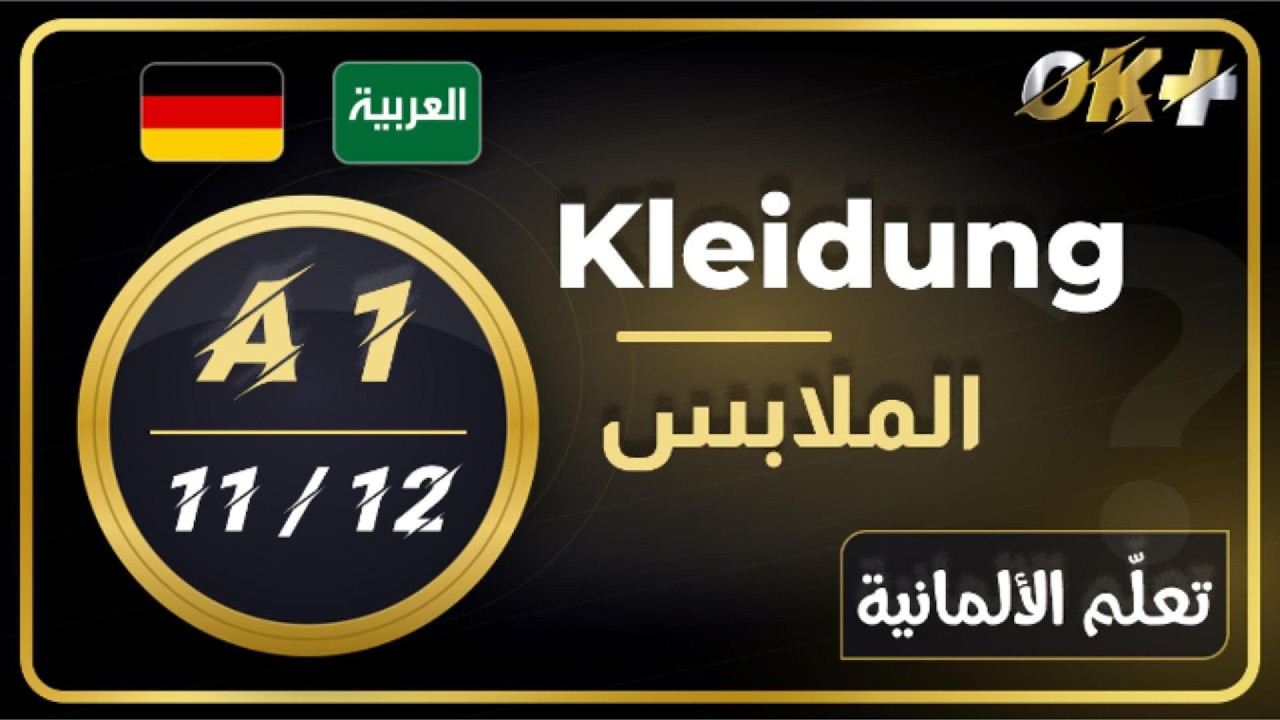
Learn German A1 – Lesson 11: What shall I wear?
This is lesson 11 of the A1 German series on the OK+ channel, and its subject is What shall I wear?. It is built for someone starting from nothing who wants to use what they learn the same day, rather than collect rules that help neither in the street nor at the office.
The grammar it works on is Verben mit Dativ (gefallen) · Komparativ und Superlativ. This page carries the rule explained, the fifteen words of the lesson, example sentences and an exercise for today.
Verben mit Dativ (gefallen) · Komparativ und Superlativ
A family of verbs turns the sentence around against a learner's expectation: gefallen, passen, gehören. The thing is the subject and the person stands in the dative: Das Hemd gefällt mir — "the shirt is pleasing to me", not "I like the shirt".
Comparison runs in three degrees: the plain adjective, then -er for the comparative, then am …-sten for the superlative. Many short adjectives also take an umlaut: groß – größer – am größten. A few are irregular and simply learned: gut – besser – am besten.
The degrees of comparison
| Deutsch | English |
|---|---|
| billig – billiger – am billigsten | cheap – cheaper – cheapest |
| groß – größer – am größten | big – bigger – biggest |
| teuer – teurer – am teuersten | expensive – more – most expensive |
| gut – besser – am besten | good – better – best |
| gern – lieber – am liebsten | gladly – rather – most of all |
| Der Mantel ist teurer als die Jacke. | The coat is dearer than the jacket. |
The fifteen words of this lesson
| Deutsch | English |
|---|---|
| die Kleidung | the clothing |
| das Hemd | the shirt |
| die Hose | the trousers |
| der Rock | the skirt |
| das Kleid | the dress |
| die Jacke | the jacket |
| der Mantel | the coat |
| die Schuhe | the shoes |
| die Mütze | the cap |
| der Schal | the scarf |
| die Größe | the size |
| die Farbe | the colour |
| anziehen | to put on |
| passen | to fit |
| gefallen | to please |
Example sentences
- Die Jacke gefällt mir. — I like the jacket.
- Diese Hose passt mir nicht. — These trousers do not fit me.
- Der Mantel ist teurer als die Jacke. — The coat is dearer than the jacket.
- Das sind die besten Schuhe. — These are the best shoes.
- Ich ziehe heute ein Hemd an. — Today I am putting on a shirt.
Today's exercise
Stand at your wardrobe, pick three items, and say three sentences about each: whether it pleases you, whether it fits, and how it compares with the one beside it. Nine sentences that bring together both new verbs and the degrees of comparison — and they take two minutes at the wardrobe, not on paper.
How to study this lesson
- Watch the lesson once end to end without stopping, to get the shape of it
- Watch it again, pausing at every new word and saying it aloud
- Write the fifteen words out by hand — writing fixes them better than reading
- Use three of the sentences the same day, even if only to yourself
- Do not move on until you can recall this vocabulary without looking
Where this lesson sits in the series
The series is twelve lessons in a deliberate order: each builds on the grammar and the vocabulary of the one before it. This is lesson 11 of twelve. Do not skip between them — skipping is the first cause of stalling at A1.
Frequently asked questions
Why Das Hemd gefällt mir and not Ich gefalle das Hemd?
Because with this verb the thing, not the person, is the subject. The shirt is what pleases; you are the one it pleases.
So how do I say I like this shirt?
Either Das Hemd gefällt mir, which is the common way, or Ich mag das Hemd with an accusative object.
What is the difference between passen and gefallen?
passen is about size and suitability; gefallen is about taste.
How do I compare two things?
Add -er to the adjective and follow with als: billiger als. Do not use wie here — that is for equality, not comparison.
Watch the video
The video is on the OK+ channel on YouTube:
https://www.youtube.com/watch?v=cvEXaynvdsE
Also on OK+
- Learn German A1 – Lesson 10: Yesterday and today
- Learn German A1 – Lesson 12: Seasons and weather
- Fifty German verbs – part one
A tool that shortens the road
The OK Plus DE app gathers German administrative calculators and form templates in one place, free, ad-free, in seven languages. Android and iPhone, from the same page:
Get the OK Plus DE app
Thank you! Your feedback helps us improve.
تابع قناة OK+ على واتساب
كل جديد عن الحياة في ألمانيا: الطلبات، والقوانين، والفرص — أولاً بأوّل.