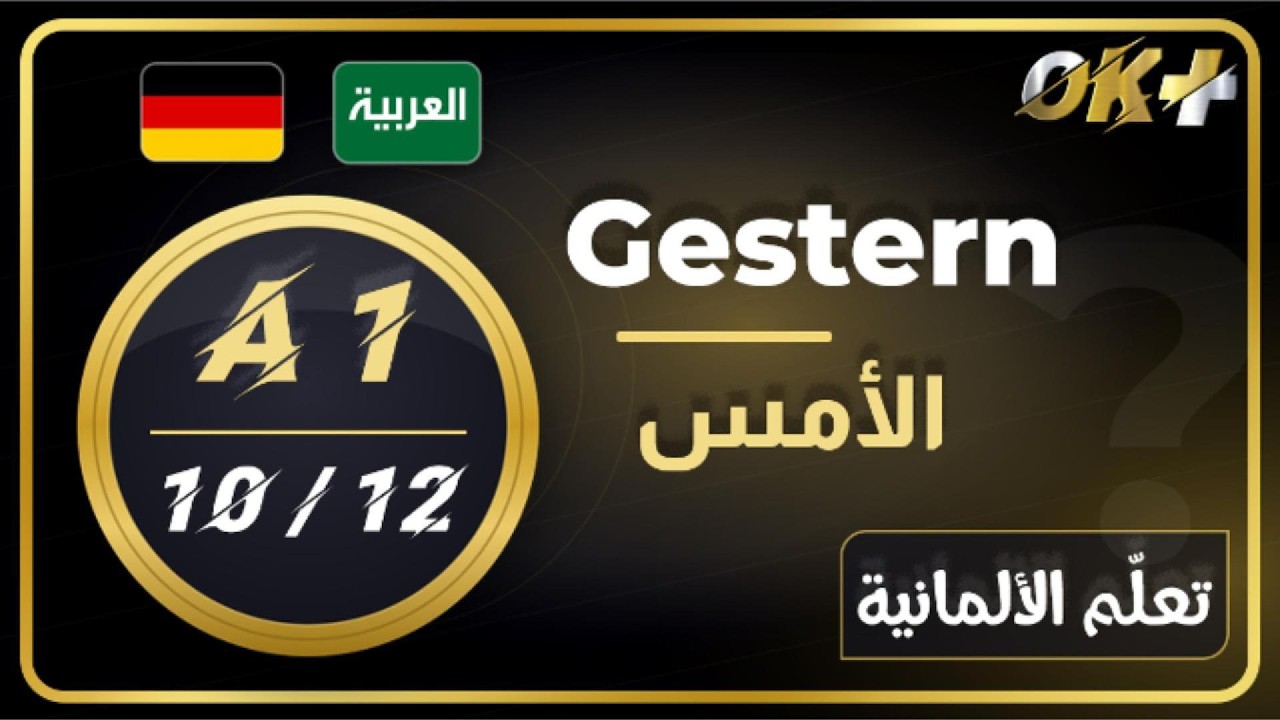
Learn German A1 – Lesson 10: Yesterday and today
This is lesson 10 of the A1 German series on the OK+ channel, and its subject is Yesterday and today. It is built for someone starting from nothing who wants to use what they learn the same day, rather than collect rules that help neither in the street nor at the office.
The grammar it works on is Perfekt · Präteritum von haben und sein. This page carries the rule explained, the fifteen words of the lesson, example sentences and an exercise for today.
Perfekt · Präteritum von haben und sein
Everyday spoken German makes the past with the Perfekt: an auxiliary conjugated in second position — haben or sein — and the past participle at the end. Ich habe gestern gearbeitet.
Most verbs take haben. Verbs of movement from place to place or of change of state — gehen, fahren, kommen, bleiben, sein — take sein.
haben and sein themselves are the exception: for them the Präteritum is the better form — ich hatte, ich war.
The past with haben and with sein
| Deutsch | English |
|---|---|
| machen → ich habe gemacht | I did / made |
| arbeiten → ich habe gearbeitet | I worked |
| essen → ich habe gegessen | I ate |
| gehen → ich bin gegangen | I went |
| fahren → ich bin gefahren | I travelled |
| sein → ich war | I was |
The fifteen words of this lesson
| Deutsch | English |
|---|---|
| gestern | yesterday |
| vorgestern | the day before yesterday |
| heute | today |
| morgen | tomorrow |
| letzte Woche | last week |
| der Monat | the month |
| das Jahr | the year |
| machen | to do, to make |
| kaufen | to buy |
| arbeiten | to work |
| gehen | to go |
| fahren | to travel, to drive |
| sehen | to see |
| haben | to have |
| sein | to be |
Example sentences
- Ich habe gestern gearbeitet. — I worked yesterday.
- Wir sind nach Köln gefahren. — We travelled to Cologne.
- Hast du das Buch gelesen? — Have you read the book?
- Er war letzte Woche krank. — He was ill last week.
- Ich hatte keine Zeit. — I had no time.
Today's exercise
Write what you did yesterday in six sentences. Then note under each one which auxiliary you used and why. You will find that every verb which took sein was a movement or a change of state — and finding that yourself holds better than a rule you read.
How to study this lesson
- Watch the lesson once end to end without stopping, to get the shape of it
- Watch it again, pausing at every new word and saying it aloud
- Write the fifteen words out by hand — writing fixes them better than reading
- Use three of the sentences the same day, even if only to yourself
- Do not move on until you can recall this vocabulary without looking
Where this lesson sits in the series
The series is twelve lessons in a deliberate order: each builds on the grammar and the vocabulary of the one before it. This is lesson 10 of twelve. Do not skip between them — skipping is the first cause of stalling at A1.
Frequently asked questions
When do I use haben and when sein?
haben with most verbs; sein with verbs of movement or change of state: gehen, fahren, kommen, bleiben, werden, sein.
Why ich war rather than ich bin gewesen?
Both are correct, but ich war is what speech uses — lighter and far more common.
How do I know a verb's past participle?
Regular verbs follow ge- + stem + -t. Irregular ones have to be learned, and at this level they are few.
Do I use the Perfekt in formal writing too?
In ordinary letters, yes. Written narrative and official texts lean on the Präteritum, which belongs to the next level.
Watch the video
The video is on the OK+ channel on YouTube:
https://www.youtube.com/watch?v=yPs4l_qNbKc
Also on OK+
- Learn German A1 – Lesson 9: At the doctor
- Learn German A1 – Lesson 11: What shall I wear?
- Fifty German verbs – part one
A tool that shortens the road
The OK Plus DE app gathers German administrative calculators and form templates in one place, free, ad-free, in seven languages. Android and iPhone, from the same page:
Get the OK Plus DE app
Thank you! Your feedback helps us improve.
تابع قناة OK+ على واتساب
كل جديد عن الحياة في ألمانيا: الطلبات، والقوانين، والفرص — أولاً بأوّل.