Learn German A1 – Lesson 1: Greetings and introducing yourself
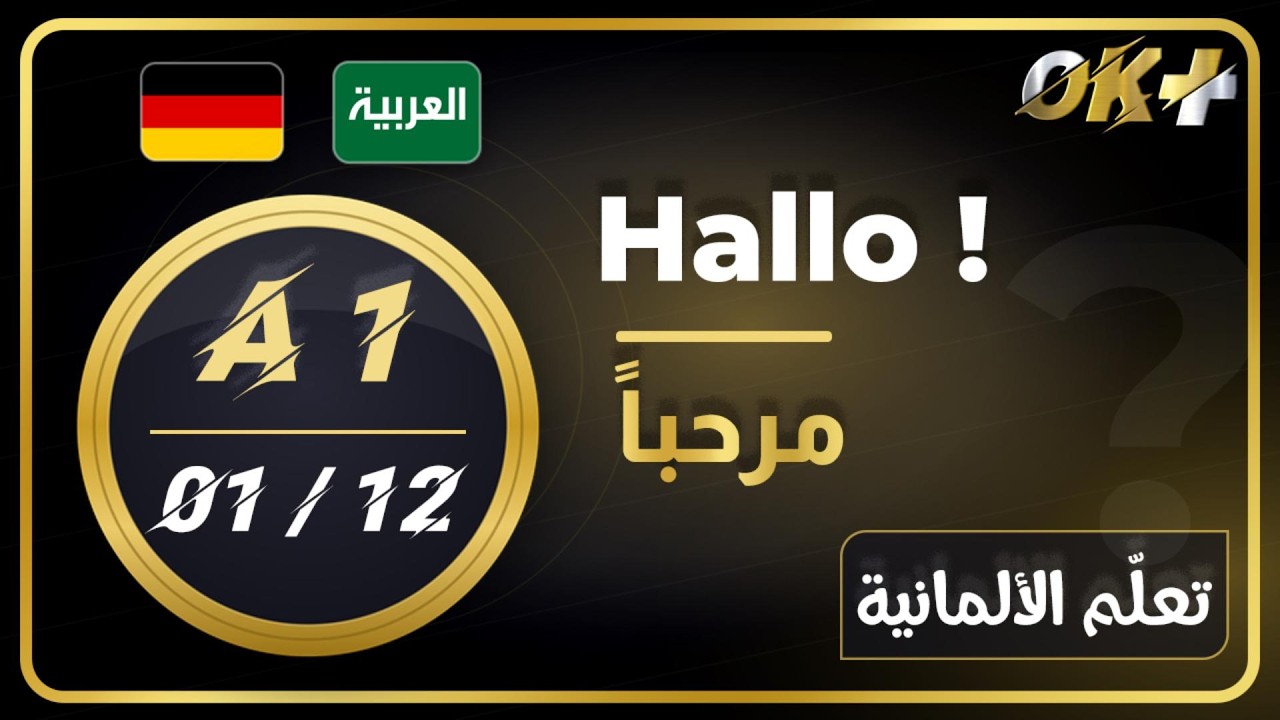
This is lesson 1 of the A1 German series on the OK+ channel, and its subject is Greetings and introducing yourself. It is built for someone starting from nothing who wants to use what they learn the same day, rather than collect rules that help neither in the street nor at the office.
The grammar it works on is Verbkonjugation · Verb an Position 2. This page carries the rule explained, the fifteen words of the lesson, example sentences and an exercise for today.
Verbkonjugation · Verb an Position 2
Two rules carry the whole German sentence. The first is that the verb ending changes with the subject, so it does not keep one shape. The second — and the more important — is that the conjugated verb always stands in position two of a statement, no matter what comes before it. If the sentence opens with Heute, the verb follows immediately and the subject moves behind it. A yes/no question, by contrast, begins with the verb itself.
The verb wohnen in the present tense
| Deutsch | English |
|---|---|
| ich wohne | I live |
| du wohnst | you live |
| er / sie / es wohnt | he / she / it lives |
| wir wohnen | we live |
| ihr wohnt | you all live |
| sie / Sie wohnen | they live / you live (formal) |
The fifteen words of this lesson
| Deutsch | English |
|---|---|
| Hallo | hello |
| Guten Morgen | good morning |
| Guten Tag | good day |
| Guten Abend | good evening |
| Tschüss | bye |
| Auf Wiedersehen | goodbye |
| Wie geht es Ihnen? | how are you? (formal) |
| Danke | thank you |
| Bitte | please / you are welcome |
| der Name | the name |
| heißen | to be called |
| kommen | to come |
| wohnen | to live, to reside |
| sprechen | to speak |
| das Land | the country |
Example sentences
- Ich heiße Okba. — My name is Okba.
- Woher kommst du? — Where do you come from?
- Ich komme aus Syrien. — I come from Syria.
- Heute wohne ich in Marl. — Today I live in Marl.
- Sprechen Sie Deutsch? — Do you speak German?
Today's exercise
Write just three sentences about yourself: your name, your country, and the town you live in. Then rewrite the third one beginning with Heute and watch the subject move behind the verb. This one exercise fixes the position-two rule better than a page of explanation.
How to study this lesson
- Watch the lesson once end to end without stopping, to get the shape of it
- Watch it again, pausing at every new word and saying it aloud
- Write the fifteen words out by hand — writing fixes them better than reading
- Use three of the sentences the same day, even if only to yourself
- Do not move on until you can recall this vocabulary without looking
Where this lesson sits in the series
The series is twelve lessons in a deliberate order: each builds on the grammar and the vocabulary of the one before it. This is lesson 1 of twelve. Do not skip between them — skipping is the first cause of stalling at A1.
Frequently asked questions
What is the difference between du and Sie?
du is for friends, family and people you know; Sie is the formal address for strangers, offices and work. The safe rule for a beginner: start with Sie until you are offered otherwise.
Why does the verb ending change?
Because German conjugates the verb for every pronoun. Learn one shape per pronoun with a single verb (wohnen), then apply it elsewhere — most verbs follow the same pattern.
Should a sentence begin with the verb?
Not in a statement; there the verb is always second. A yes/no question does begin with the verb: Sprechen Sie Deutsch?
How many words are in this lesson?
Fifteen core words — the ones in the vocabulary table above.
Watch the video
The video is on the OK+ channel on YouTube:
https://www.youtube.com/watch?v=H6mfip_OFCM
Also on OK+
A tool that shortens the road
The OK Plus DE app gathers German administrative calculators and form templates in one place, free, ad-free, in seven languages. Android and iPhone, from the same page:
Get the OK Plus DE app
Thank you! Your feedback helps us improve.
تابع قناة OK+ على واتساب
كل جديد عن الحياة في ألمانيا: الطلبات، والقوانين، والفرص — أولاً بأوّل.