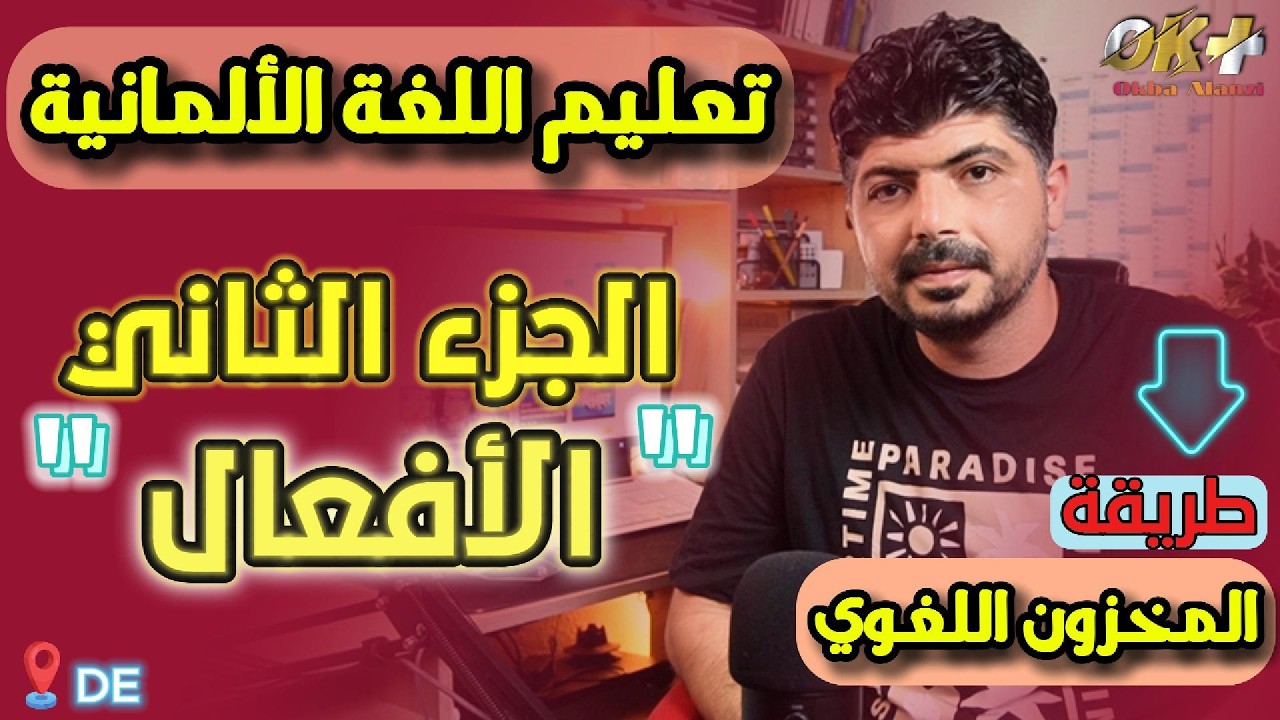
Fifty verbs for building your German vocabulary – part two
Part two of the vocabulary series: fifty further German verbs, with nothing repeated from part one. Anyone who completes both parts owns a hundred verbs — a store that covers most of what happens in a day.
The table on this page gathers twenty-five verbs of the home, of work and of dealing with people — the ones needed once a learner moves past greetings and introductions.
Why a store of words is built by volume, not by rule
Grammar organises what you already know; it does not produce what you do not. Someone who still cannot speak in the street after a year of study is usually short of words, not of rules. That is why this series comes in batches: fifty words at a time, heard, repeated and used, rather than analysed and explained. Anyone measuring their own progress knows that the distance between one level and the next is counted in words before it is counted in anything else.
Twenty-five verbs of the working day
| Deutsch | English |
|---|---|
| lesen | to read |
| schreiben | to write |
| hören | to hear |
| lernen | to learn |
| fahren | to drive, travel |
| laufen | to run, to walk |
| schlafen | to sleep |
| öffnen | to open |
| schließen | to close |
| bringen | to bring |
| tragen | to carry, to wear |
| helfen | to help |
| warten | to wait |
| suchen | to look for |
| zeigen | to show |
| brauchen | to need |
| bezahlen | to pay |
| anrufen | to call, phone |
| treffen | to meet |
| spielen | to play |
| kochen | to cook |
| putzen | to clean |
| vergessen | to forget |
| erklären | to explain |
| ändern | to change |
How to fix a word so it does not slip away
- Listen to the part once through, then again while pronouncing along with it, not after it
- Split the fifty over five days, ten a day — a single large batch is forgotten whole
- Review yesterday's words before starting today's; two minutes are enough
- Write one sentence per word taken from your own life, not from a book
- Review the whole part after a week and again after a month — spacing is what moves a word into long-term memory
- Anything forgotten twice goes on a small separate list and is reviewed on its own
Frequently asked questions
Are a hundred verbs enough to speak?
Enough to make yourself understood in most daily situations. Fluency comes after that from heavy use, not from the count alone.
Which verbs should I start with?
The ones attached to your own day. Someone working in a kitchen puts kochen and bringen first; someone dealing with offices puts brauchen and erklären first.
Should I learn the English meaning or the German gloss?
Start with the meaning until it settles, then move to the German gloss on the second review — that shift is what separates you from mental translation.
How long does one part take?
Five days at ten words a day, with two minutes of review before each session.
Watch the video
The video is on the OK+ channel on YouTube:
https://www.youtube.com/watch?v=4aGBtyxHC_s
Also on OK+
- Fifty verbs for building your German vocabulary – part one
- Fifty nouns for building your German vocabulary – part three
- Learn German A1 – lesson 1
A tool that shortens the road
The OK Plus DE app gathers German administrative calculators and form templates in one place, free, ad-free, in seven languages. Android and iPhone, from the same page:
Get the OK Plus DE app
Thank you! Your feedback helps us improve.
تابع قناة OK+ على واتساب
كل جديد عن الحياة في ألمانيا: الطلبات، والقوانين، والفرص — أولاً بأوّل.