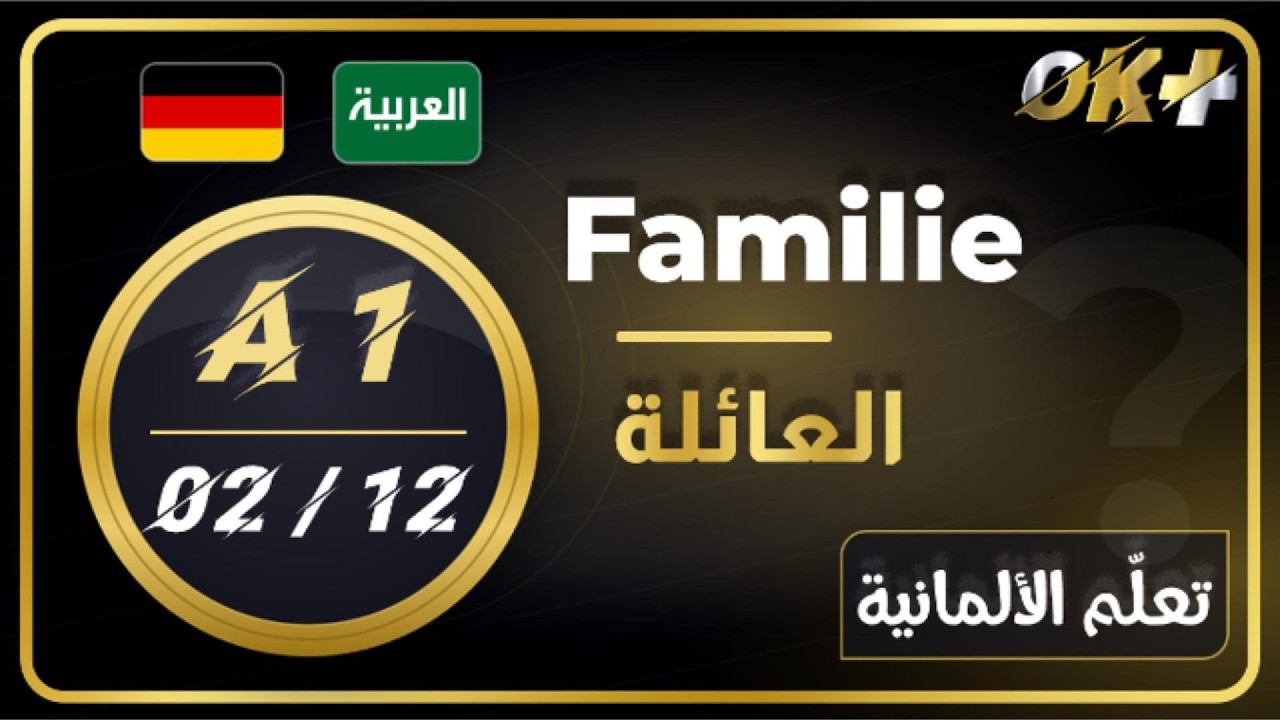
Learn German A1 – Lesson 2: My family and I
This is lesson 2 of the A1 German series on the OK+ channel, and its subject is My family and I. It is built for someone starting from nothing who wants to use what they learn the same day, rather than collect rules that help neither in the street nor at the office.
The grammar it works on is Possessivartikel (mein, dein) · Plural. This page carries the rule explained, the fifteen words of the lesson, example sentences and an exercise for today.
Possessivartikel (mein, dein) · Plural
A German possessive follows the thing owned, not the owner: mein Vater takes no ending because the noun is masculine, meine Mutter adds -e because it is feminine, mein Kind takes none because it is neuter, and meine Eltern adds -e because it is plural. The plural itself follows no single rule, which is why a noun should be learned together with its article and its plural from the first day.
Common plural patterns
| Deutsch | English |
|---|---|
| das Kind – die Kinder | the child – the children |
| der Sohn – die Söhne | the son – the sons |
| die Tochter – die Töchter | the daughter – the daughters |
| der Bruder – die Brüder | the brother – the brothers |
| die Schwester – die Schwestern | the sister – the sisters |
| der Mann – die Männer | the man – the men |
The fifteen words of this lesson
| Deutsch | English |
|---|---|
| die Familie | the family |
| die Eltern | the parents |
| der Vater | the father |
| die Mutter | the mother |
| der Bruder | the brother |
| die Schwester | the sister |
| die Geschwister | the siblings |
| das Kind | the child |
| der Sohn | the son |
| die Tochter | the daughter |
| die Großeltern | the grandparents |
| der Mann | the man, the husband |
| die Frau | the woman, the wife |
| verheiratet | married |
| ledig | single |
Example sentences
- Das ist meine Familie. — This is my family.
- Mein Vater heißt Ahmad. — My father is called Ahmad.
- Meine Mutter kommt aus Aleppo. — My mother comes from Aleppo.
- Ich habe zwei Brüder und eine Schwester. — I have two brothers and a sister.
- Wie heißt dein Sohn? — What is your son called?
Today's exercise
Draw your family tree on paper and write two things under each person: the German relationship word with the correct possessive (mein / meine) and the name. Then read it aloud. You will find for yourself that the mistakes fall on the feminine and the plural — which is exactly what needs repeating.
How to study this lesson
- Watch the lesson once end to end without stopping, to get the shape of it
- Watch it again, pausing at every new word and saying it aloud
- Write the fifteen words out by hand — writing fixes them better than reading
- Use three of the sentences the same day, even if only to yourself
- Do not move on until you can recall this vocabulary without looking
Where this lesson sits in the series
The series is twelve lessons in a deliberate order: each builds on the grammar and the vocabulary of the one before it. This is lesson 2 of twelve. Do not skip between them — skipping is the first cause of stalling at A1.
Frequently asked questions
Why mein sometimes and meine at others?
Because the possessive follows the gender of the noun after it: no ending for masculine and neuter, -e for feminine and plural.
How do I memorise plurals?
Learn every noun as three things from day one: article, singular, plural — das Kind – die Kinder. Learning the bare singular costs you double the time later.
What is the difference between Eltern and Großeltern?
Eltern are parents, Großeltern grandparents. Both are plural-only in normal use.
Does Frau mean woman or wife?
Both; context decides. meine Frau is my wife, eine Frau is a woman.
Watch the video
The video is on the OK+ channel on YouTube:
https://www.youtube.com/watch?v=uyAuN1TsxSo
Also on OK+
- Learn German A1 – Lesson 1: Greetings and introducing yourself
- Learn German A1 – Lesson 3: Learning German
- Fifty German verbs – part one
A tool that shortens the road
The OK Plus DE app gathers German administrative calculators and form templates in one place, free, ad-free, in seven languages. Android and iPhone, from the same page:
Get the OK Plus DE app
Thank you! Your feedback helps us improve.
تابع قناة OK+ على واتساب
كل جديد عن الحياة في ألمانيا: الطلبات، والقوانين، والفرص — أولاً بأوّل.