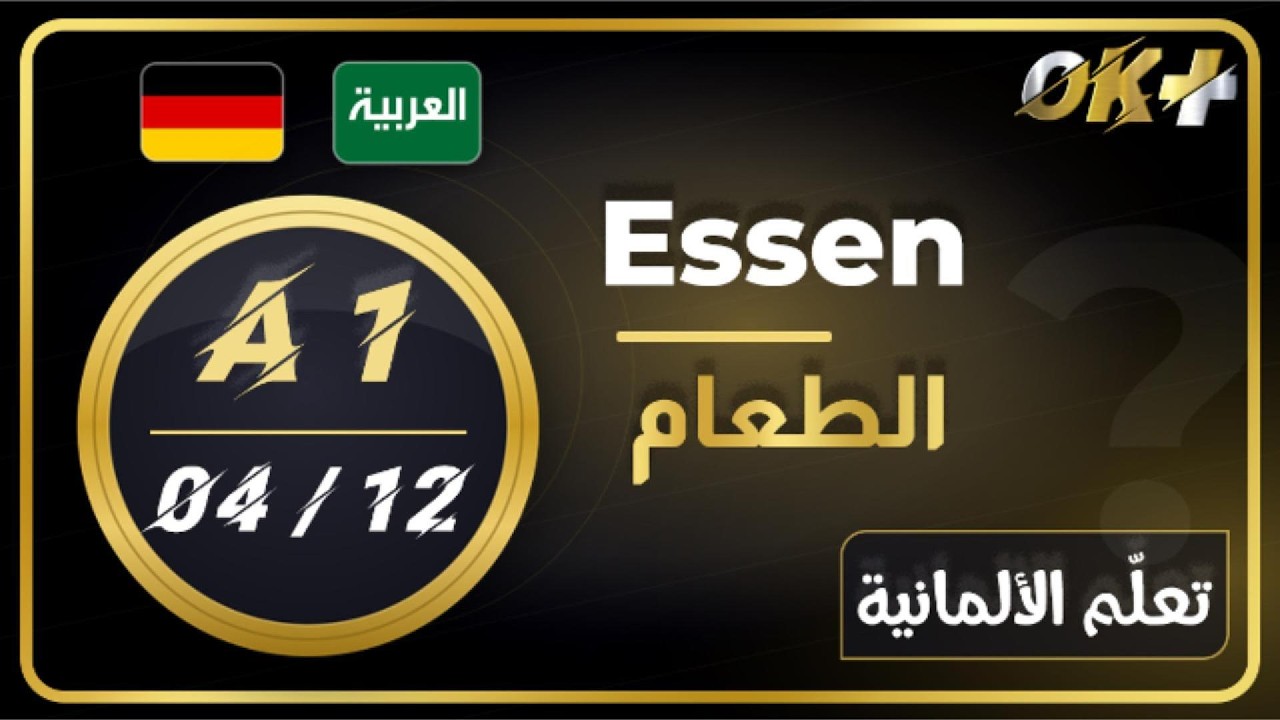
Learn German A1 – Lesson 4: Food and drink
This is lesson 4 of the A1 German series on the OK+ channel, and its subject is Food and drink. It is built for someone starting from nothing who wants to use what they learn the same day, rather than collect rules that help neither in the street nor at the office.
The grammar it works on is Akkusativ · Verben mit Vokalwechsel. This page carries the rule explained, the fifteen words of the lesson, example sentences and an exercise for today.
Akkusativ · Verben mit Vokalwechsel
When a noun becomes the direct object, its article changes — but only in the masculine: der → den, ein → einen. Feminine, neuter and plural articles stay as they are. That is good news for a beginner: there is exactly one new form to learn in this lesson.
The second rule is that a family of verbs changes its stem vowel in du and er/sie/es only: essen → du isst, er isst, nehmen → du nimmst, er nimmt. In every other person the verb keeps its original vowel.
Verbs that change their stem vowel
| Deutsch | English |
|---|---|
| essen – du isst – er isst | to eat |
| nehmen – du nimmst – er nimmt | to take |
| geben – du gibst – er gibt | to give |
| lesen – du liest – er liest | to read |
| sprechen – du sprichst – er spricht | to speak |
| fahren – du fährst – er fährt | to drive |
The fifteen words of this lesson
| Deutsch | English |
|---|---|
| das Essen | the food |
| das Brot | the bread |
| das Wasser | the water |
| die Milch | the milk |
| der Käse | the cheese |
| das Fleisch | the meat |
| das Gemüse | the vegetables |
| das Obst | the fruit |
| der Reis | the rice |
| das Ei | the egg |
| der Zucker | the sugar |
| das Salz | the salt |
| essen | to eat |
| trinken | to drink |
| kaufen | to buy |
Example sentences
- Ich esse einen Apfel. — I am eating an apple.
- Er nimmt den Käse. — He takes the cheese.
- Trinkst du Milch? — Do you drink milk?
- Wir kaufen das Brot. — We buy the bread.
- Sie isst kein Fleisch. — She eats no meat.
Today's exercise
Write your next shopping list in German, then put every item into a sentence beginning Ich kaufe …. Only the masculine items will force you into den or einen — and those are the test of whether the case has really settled.
How to study this lesson
- Watch the lesson once end to end without stopping, to get the shape of it
- Watch it again, pausing at every new word and saying it aloud
- Write the fifteen words out by hand — writing fixes them better than reading
- Use three of the sentences the same day, even if only to yourself
- Do not move on until you can recall this vocabulary without looking
Where this lesson sits in the series
The series is twelve lessons in a deliberate order: each builds on the grammar and the vocabulary of the one before it. This is lesson 4 of twelve. Do not skip between them — skipping is the first cause of stalling at A1.
Frequently asked questions
Do all articles change in the accusative?
No — only the masculine: der → den, ein → einen. The rest stay as they are.
How do I know which verbs change their vowel?
There is no reliable rule; it is a limited set that has to be learned. The table above gathers the ones most used at this level.
Why du isst and not du esst?
Because the change happens in du and er only, turning e into i. The other persons keep the original: wir essen.
Can I say Ich esse Brot with no article?
Yes — that is correct and common when speaking of the substance in general rather than a particular piece.
Watch the video
The video is on the OK+ channel on YouTube:
https://www.youtube.com/watch?v=0zxq93bRIak
Also on OK+
- Learn German A1 – Lesson 3: Learning German
- Learn German A1 – Lesson 5: My day
- Fifty German verbs – part one
A tool that shortens the road
The OK Plus DE app gathers German administrative calculators and form templates in one place, free, ad-free, in seven languages. Android and iPhone, from the same page:
Get the OK Plus DE app
Thank you! Your feedback helps us improve.
تابع قناة OK+ على واتساب
كل جديد عن الحياة في ألمانيا: الطلبات، والقوانين، والفرص — أولاً بأوّل.